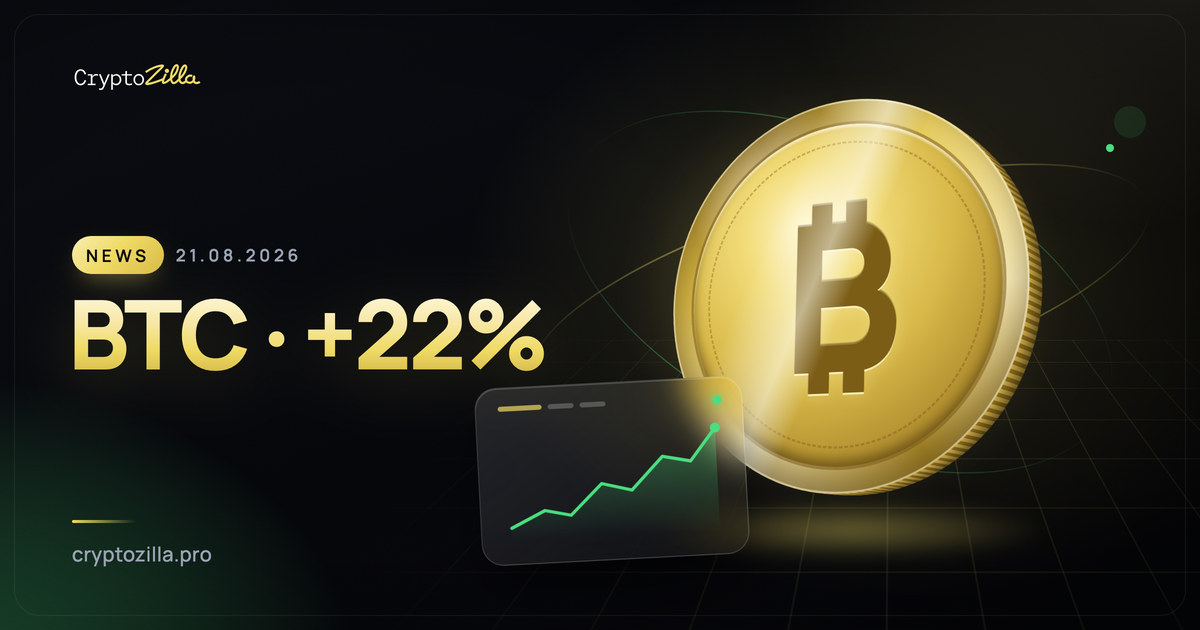
Short answer: On August 21, 2026, Bitcoin closed its best week since March 2023, finishing Friday near $76,900 after starting the week at about $62,800, a gain of roughly 22%. The rally was set off by the U.S. Treasury's decision to double its long-bond buybacks, then amplified by a record short squeeze, strong ETF inflows and a White House push for the Clarity Act.
What happened
For six weeks Bitcoin (BTC) had been stuck between roughly $60,000 and $65,000, after sliding to a 2026 low near $58,000 at the end of June. That range broke on Wednesday, August 19, and the move did not stop until Friday. According to CNBC, Bitcoin ended August 21 about 6% higher on the day at $76,943.90, putting the weekly gain at around 22%. Intraday it traded as high as about $79,300, and Bloomberg described it as the biggest weekly rally in more than three years. The only larger week in recent history was the rebound after the collapse of Silicon Valley Bank in March 2023.
The rest of the market moved with it. Ether (ETH) rose more than 20% on the week to around $2,400, XRP gained roughly 40%, and Solana, Cardano and Dogecoin each added about 20%. Listed crypto companies followed: on Friday alone Robinhood rose almost 14% and Coinbase about 8%.
Why the Treasury buyback moved Bitcoin
The trigger came from the bond market, not from crypto. On August 19 the U.S. Department of the Treasury said it would at least double its liquidity support buybacks in the 10-to-20-year and 20-to-30-year sectors, raising the maximum per operation from $2 billion to at least $4 billion. The larger operations run from September 9 until the November 4 quarterly refunding.
A buyback is the government repurchasing its own older bonds before they mature. Buying at the long end removes supply exactly where demand had been weakest, and yields fell at once: the 10-year note closed about 5.7 basis points lower at 4.647%, and the 30-year bond dropped about 9 basis points to 5.196%, according to CNBC.
| Indicator | Before / start of week | After / end of week |
|---|---|---|
| Treasury buyback cap (10–30-year sectors) | $2 billion per operation | At least $4 billion per operation |
| 30-year Treasury yield (Aug 19 close) | about 5.29% | 5.196% |
| Bitcoin price | about $62,800 | about $76,900 |
| Ether price | under $2,000 | about $2,400 |
Lower long-term yields make non-yielding assets such as Bitcoin and gold relatively more attractive, and they ease the pressure on risk assets in general. The same week, U.S. federal debt passed $40 trillion, which strengthened the "debasement" argument that many Bitcoin buyers use: that governments will keep supporting bond markets rather than let rates spike.
How a record short squeeze accelerated the rally
A short squeeze happens when traders who bet on a falling price are forced to buy back as the price rises, pushing it higher still. Derivatives markets were heavily tilted towards shorts after weeks of a flat range, so when Bitcoin cleared $70,000 for the first time since June, liquidations cascaded. CoinGlass data cited by CNBC showed about $2.7 billion of short positions wiped out, and CoinDesk counted about $4 billion across the two-day move.
The rally was not only leverage, though. U.S. spot Bitcoin exchange-traded funds (ETFs) took in about $517 million on August 19 and about $606 million on August 20, their strongest days since early May, with BlackRock's iShares Bitcoin Trust (IBIT) alone drawing about $503 million on Thursday. Ether ETFs also recorded net inflows.
Why the Clarity Act is back in the picture
The second driver was political. At a White House event with industry leaders, President Donald Trump urged Congress to pass the Clarity Act, the market-structure bill that would divide oversight of crypto between the Securities and Exchange Commission (SEC) and the Commodity Futures Trading Commission (CFTC). The bill has been stalled in the Senate over how tokens are classified and whether stablecoin holders may earn yield. The push did not change the vote count, but it revived hopes of the clear U.S. rules many institutions want before allocating more.
What it means for you
A week like this changes prices quickly, and it also changes the conditions for anyone moving coins:
- Volatility cuts both ways. A 20% week driven partly by forced short covering can partly reverse once liquidations are exhausted. Bitcoin is still about 39% below its October 2025 all-time high of $126,198.
- Watch the rate you lock in. In fast markets, a quote can move between creating an order and sending funds. A fixed rate removes that risk for a small premium; see fixed vs floating exchange rates.
- Leverage is the main danger. The billions liquidated this week belonged mostly to leveraged short sellers; the same mechanics hit leveraged buyers just as hard when the market turns.
- Taking profit is a taxable event in most countries, including a swap into a stablecoin.
Key takeaways
- Bitcoin gained about 22% in the week to August 21, 2026, closing near $76,900: its best week since March 2023.
- The U.S. Treasury doubled its long-bond buyback cap from $2 billion to at least $4 billion per operation, pushing long yields down.
- About $2.7 billion in short positions were liquidated, adding fuel to the move.
- Spot Bitcoin ETFs drew about $517 million on August 19 and $606 million on August 20, their strongest days since early May.
- President Trump's call to pass the Clarity Act lifted sentiment, but the bill remains stalled in the Senate.
If you are rebalancing after the rally, you can see the exact amount you would receive for BTC, ETH or stablecoins in the exchange calculator before creating an order.
Sources: CNBC, U.S. Department of the Treasury, CoinDesk, Investing.com
Frequently asked questions
Why did Bitcoin go up so much in August 2026?
The U.S. Treasury said on August 19, 2026 that it would double its long-bond buybacks, which pushed long-term yields down. A roughly $2.7 billion short squeeze, strong spot ETF inflows and President Trump's push for the Clarity Act added to the move.
What is a Treasury buyback and why does it matter for crypto?
A buyback is the U.S. Treasury repurchasing its own outstanding bonds before maturity. Buying long-dated bonds lowers their yields, which makes non-yielding assets like Bitcoin relatively more attractive and eases pressure on risk assets.
Is Bitcoin back at its all-time high?
No. Even after closing near $76,900 on August 21, 2026, Bitcoin remained roughly 39% below its all-time high of $126,198, set on October 6, 2025.